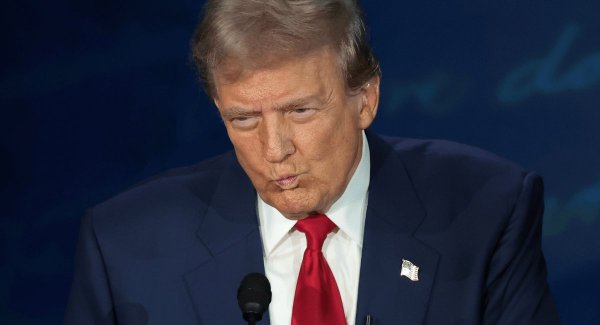
In the aftermath of Tuesday’s presidential debate, a prominent psychiatrist has voiced serious concerns about Donald Trump’s mental agility, describing his verbal performance as “alarming” and a potential indicator of underlying cognitive issues. Richard A. Friedman, a professor of psychiatry at Weill Cornell Medical College, wrote in The Atlantic that the debate served as a real-world cognitive test, and that any fair-minded expert would be worried by what they saw.
Friedman, who clarified he has never examined either candidate and is not offering a formal diagnosis, said he watched the 90-minute event with a focus on vocabulary and logical flow. While Vice President Kamala Harris showed some repetition, her overall performance appeared within normal bounds. Trump, however, exhibited what Friedman described as “circumstantial and tangential speech,” which can signal problems with goal-oriented thinking.
One notable moment came when Trump, asked about his January 6 statements, veered into unrelated topics like “blood baths,” Charlottesville, and the border. Friedman noted that such evasiveness has long been part of Trump’s style, but the debate displayed a more pronounced incoherence than in past years, when he was sharper in attacks on rivals like Marco Rubio and Hillary Clinton.
Why Experts Are Concerned
Friedman pointed to “perseverance”—the repetition of words or concepts—as a symptom that can be linked to conditions such as Parkinson’s or schizophrenia. He stressed that while these signs are worrying, they are not conclusive without a thorough medical exam. “If a patient presented to me with the verbal incoherence, tangential thinking, and repetitive speech that Trump now regularly demonstrates, I would almost certainly refer them for a rigorous neuropsychiatric evaluation,” he wrote.
The psychiatrist also criticized the simplicity of standard mental status exams, which often ask basic questions like the date or spelling words backward. These tests, he argued, are far easier than a live debate and do not capture the complexity of real-world cognition. For a man nearing 80, dementia or Alzheimer’s are not uncommon, but Friedman cautioned that only a proper evaluation can confirm any diagnosis.
The debate performance has already had ripple effects, with Trump’s social media company’s stock hitting an all-time low shortly after. While Friedman’s comments are not a diagnosis, they add to a growing public conversation about the candidates’ fitness for office—a topic that is likely to remain central as the election approaches.
For now, Friedman’s advice is clear: observing from afar is not enough. “Only careful medical examination can establish whether someone indeed has a diagnosable illness,” he concluded.