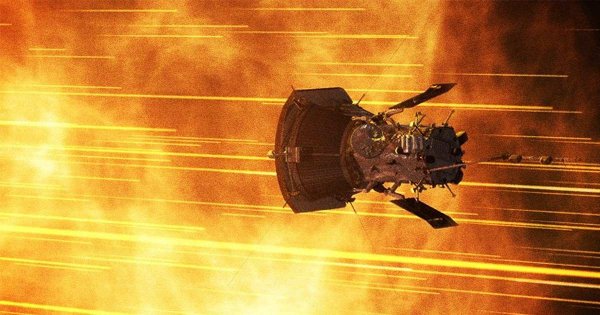
On Christmas Eve, a NASA spacecraft will make its closest approach to the Sun, flying through the star's outer atmosphere in a mission to uncover the origins of the solar wind. The Parker Solar Probe, launched in 2018, will come within 3.8 million miles of the solar surface, a record for any human-made object. This maneuver places the probe directly into the corona, the Sun's upper atmosphere, where temperatures can reach millions of degrees.
The mission's goal, as stated by NASA's chief of science Nicky Fox, is to find the birthplace of the solar wind, a constant stream of charged particles that fills the solar system. The corona, visible during solar eclipses as a glowing halo, is the source of this wind, but the exact mechanisms that accelerate it to speeds of about one million miles per hour remain unclear.
Scientists have long puzzled over the corona's extreme heat. Despite being farther from the Sun's core, the corona is hundreds of times hotter than the surface, reaching temperatures up to 3.6 million degrees Fahrenheit, compared to a relatively mild 10,000 degrees on the surface. This paradox has led to ongoing debates about the physical processes that heat the corona.
The Parker Solar Probe has previously 'touched' the Sun, making a historic flyby within the corona in 2021. However, this upcoming approach will take it deeper into the corona than ever before, providing unprecedented data. The spacecraft, which weighs less than a ton, has been performing flybys of the Sun at record-breaking speeds since its launch.
Engineering for Extreme Heat
Surviving such a close encounter requires a delicate balance of orbital mechanics and materials engineering. The probe must orbit at a distance where it can gather data slowly enough to be useful, yet be able to exit quickly to avoid melting. The spacecraft's design must withstand both the extreme heat and rapid temperature changes, as Fox explained: materials can become brittle or change properties under such conditions, which is unacceptable for a spacecraft that needs to remain lightweight and durable.
The data collected during this flyby could help explain the solar wind's acceleration and the corona's heating, which have implications for understanding space weather and its effects on Earth. The mission honors astrophysicist Eugene Parker, who predicted the existence of solar wind nearly 70 years ago.
As the Parker Solar Probe makes its Christmas Eve plunge, scientists and engineers will be watching closely, hoping for a successful pass that will send back valuable data. The spacecraft is expected to emerge from the corona intact, continuing its mission to unlock the Sun's secrets.