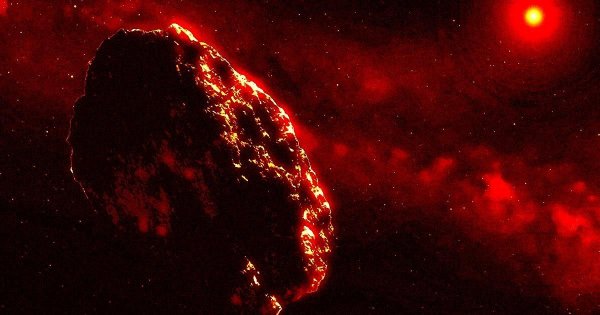
CAPE CANAVERAL, Fla. — A small asteroid that had been gravitationally tethered to Earth for two months has now drifted away, but it is expected to make a brief encore appearance in January before vanishing for three decades.
The object, designated 2024 PT5, measures roughly 33 feet across and was first detected by astronomers in August. For much of the late summer, it circled our planet in a horseshoe-shaped path, held in place by Earth's gravitational pull. That grip, however, has now yielded to the far stronger influence of the Sun, according to a report from the Associated Press.
Scientists say the space rock never posed any threat, maintaining a safe distance throughout its visit. It is likely one of many such objects that drift through Earth's neighborhood, a reality that Harvard asteroid dynamics researcher Federica Spoto described to the New York Times in September as evidence of “a pretty busy highway around the Earth.”
Despite its informal label as a “mini moon,” 2024 PT5 never completed a full orbit. Carlos de la Fuente Marcos, a professor at the Universidad Complutense de Madrid and lead author of a paper on the asteroid published in the journal Research Notes of the AAS, explained to Space.com that objects like this are more like “window shoppers” than true customers. He noted that only two other objects, 2006 RH120 and 2020 CD3, have been observed in long-term captures that temporarily bind them to Earth.
One of the more intriguing aspects of 2024 PT5 is its possible origin. Researchers believe it may have been chipped off the Moon itself, the result of an asteroid impact millions of years ago. The object is thought to belong to the Arjuna asteroid belt, a group of space rocks that follow an orbit similar to Earth's.
January Return and Radar Observation
Although 2024 PT5 was too faint to be seen with amateur telescopes or binoculars, NASA is preparing to track its upcoming visit in January using a radar antenna, as reported by the AP. That encounter is expected to be equally brief, and after it, the asteroid will not return for another 30 years.
The departure of 2024 PT5 serves as a reminder of the dynamic and crowded environment around our planet, where small objects frequently come and go, often unnoticed.