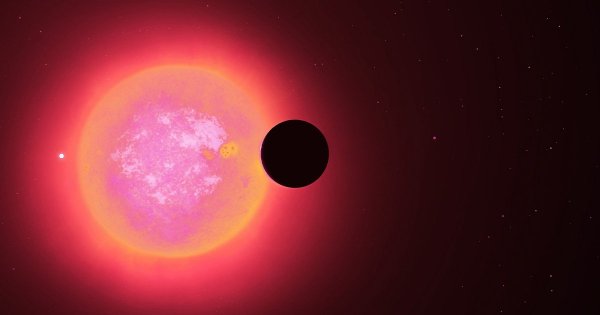
Astronomers have confirmed the existence of a planet circling Barnard's star, the nearest single star to our Solar System, located just six light-years away. The newly identified world, named Barnard b, is a sub-Earth with a mass roughly half that of Venus, or about three times the mass of Mars.
The finding, published in the journal Astronomy & Astrophysics, marks the first verified detection of a planet around Barnard's star. It also places Barnard b among the closest known exoplanets to Earth, trailing only the planets in the Alpha Centauri system, which lies about 4.1 light-years away.
Because Barnard's star is a solitary star, its planetary system more closely mirrors our own than the multi-star Alpha Centauri arrangement. However, Barnard b is not a candidate for habitability. It orbits extremely close to its host star, completing a full revolution in just over three Earth days, and sits about twenty times closer to its star than Mercury does to the Sun.
“Barnard b is one of the lowest-mass exoplanets known and one of the few known with a mass less than that of Earth,” said study lead author Jonay González Hernández, a researcher at the Instituto de Astrofísica de Canarias in Spain. “But the planet is too close to the host star, closer than the habitable zone. Even if the star is about 2500 degrees cooler than our Sun, it is too hot there to maintain liquid water on the surface.”
The detection was made using the Echelle Spectrograph for Rocky Exoplanet- and Stable Spectroscopic Observations, or ESPRESSO, an instrument on the Very Large Telescope in Chile. Rather than imaging the planet directly, the team looked for a subtle “wobble” in the star's motion caused by the gravitational tug of the orbiting planet—a technique well suited for finding planets that hug their stars closely.
Despite its tight orbit, Barnard b's surface temperature is estimated at just over 250 degrees Fahrenheit, which is cooler than Mercury or Venus. That is because Barnard's star is a red dwarf, a class of small, low-temperature stars that emit relatively little light, making them prime targets for planet searches.
The confirmation came after years of observations, which were cross-checked with data from other observatories. The researchers also reported tentative signs of three additional exoplanet candidates orbiting Barnard's star, though those signals require further observation to confirm.
“We now need to continue observing this star to confirm the other candidate signals,” said coauthor Alejandro Suárez Mascareño, also of the Instituto de Astrofísica de Canarias. “But the discovery of this planet, along with other previous discoveries such as Proxima b and d, shows that our cosmic backyard is full of low-mass planets.”
The finding adds to a growing understanding of the prevalence of low-mass planets around nearby stars, and underscores the value of long-term monitoring with high-precision instruments like ESPRESSO.