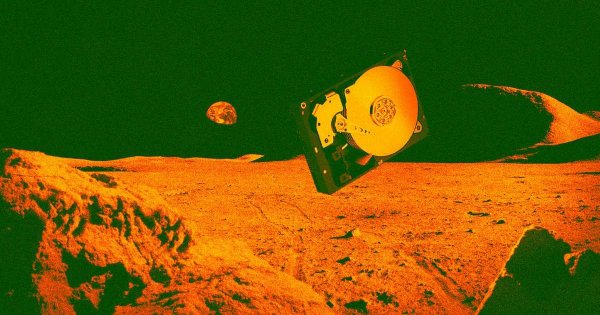
An Israeli spacecraft is carrying a disc containing 25,000 books, a full copy of Wikipedia, and language guides to the Moon, where it is intended to remain for billions of years. The archive, dubbed the Lunar Library, was developed by the Arch Mission Foundation and launched Thursday aboard a SpaceX Falcon 9 rocket.
The disc is equivalent to a 30-million-page volume, according to CNET, and is designed to preserve humanity's collective knowledge and history long after our species is gone. The mission is part of a broader strategy to place multiple backups of human knowledge across the solar system, said Nova Spivack, co-founder of the Arch Mission Foundation.
“The idea is to place enough backups in enough places around the solar system, on an ongoing basis, that our precious knowledge and biological heritage can never be lost,” Spivack told CNET. The Lunar Library is the first such archive to land on the Moon, following a test version that flew on Elon Musk's Tesla Roadster during a previous SpaceX launch.
Why a Lunar Archive?
The project responds to existential risks such as climate change or other catastrophic events that could wipe out civilization. Spivack emphasized the need for a “plan B,” noting that the strategy is “many copies, many places,” with regular updates planned. The Lunar Library is one of several caches that future civilizations might discover, though they would need to develop space travel and locate the archives to access the data.
The disc is carried by a lander built by SpaceIL, an Israeli nonprofit that competed in the Google Lunar X Prize. The lander is part of a private mission to the Moon, and the Lunar Library is a secondary payload. The archive includes information on understanding Earthly languages, which could help any future finders decode the contents.
While the mission is a milestone for private space exploration, the Lunar Library's long-term goal is to ensure that humanity's achievements are not lost. Spivack expressed optimism that humanity will address planetary risks, but the archive serves as a precautionary measure.
The launch marks a step toward the Arch Mission Foundation's vision of a distributed archive, with future missions planned to place similar libraries on other celestial bodies. The Lunar Library is designed to last for billions of years, offering a durable record of human knowledge.