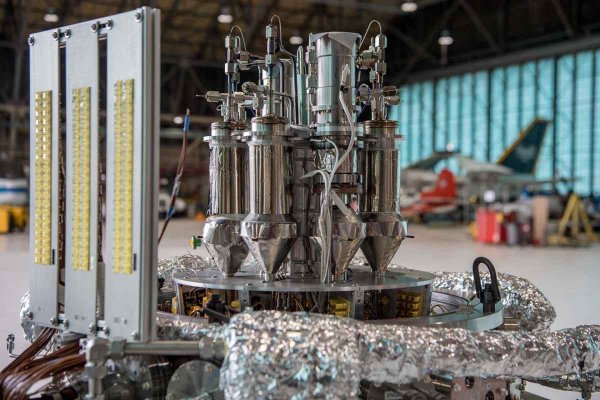
NASA, in partnership with the U.S. Department of Energy and Los Alamos National Laboratory, is advancing a compact nuclear fission reactor designed to power future outposts on Mars and the Moon. Known as Kilopower, the system has undergone successful testing and could become a cornerstone of long-duration human missions beyond Earth.
The Kilopower prototype is about the size of a coffee can and uses a uranium core to generate between 1 and 10 kilowatts of electrical power, capable of running for up to a decade. While 10 kilowatts exceeds the average household consumption on Earth, NASA's needs for a crewed Mars mission are far greater. Lee Mason, NASA's principal technologist for power and energy storage, told Reuters that a human mission would likely require 40 to 50 kilowatts to sustain life support, communications, and scientific equipment.
To meet that demand, NASA envisions deploying multiple Kilopower units. Pat McClure, the Kilopower project lead at Los Alamos, explained to Popular Science that the reactor's compact size offers advantages in predictability and control. Unlike larger reactors, Kilopower is designed to be inherently safe: its physics ensure that it produces only as much heat as is being drawn from it, reducing the risk of meltdown. "Melting fuel would be difficult if not impossible for the applications that we're doing," McClure said.
The reactor is built to withstand extreme environments. On Mars, solar power can be disrupted by seasonal changes and dust storms that last for months. On the Moon, nights extend for 14 days. Kilopower is specifically engineered to operate under these conditions, opening up new regions for exploration. Mason noted in a NASA release that Kilopower "opens up the full surface of Mars, including the northern latitudes where water may reside," and could be deployed on the Moon to search for resources in permanently shadowed craters.
Testing and Commercial Interest
According to McClure, the 1-kilowatt version of Kilopower is intended for deep space missions, while the 10-kilowatt version could be used for Mars surface operations, with five units sent to provide the necessary power. NASA has also engaged in discussions with commercial entities about using Kilopower for their own space projects, though no companies have been named.
The project is moving toward readiness. Throughout the month, NASA plans to connect the power system to the reactor core for end-to-end checkouts, which are expected to continue until late March, followed by a full-power test lasting approximately 28 hours.
If deployed, Kilopower would mark the United States' second nuclear fission reactor in space, following the SNAP 10A launched in 1965, which operated for 43 days. With its robust design and scalable approach, Kilopower represents a significant step toward sustainable off-world habitation.